


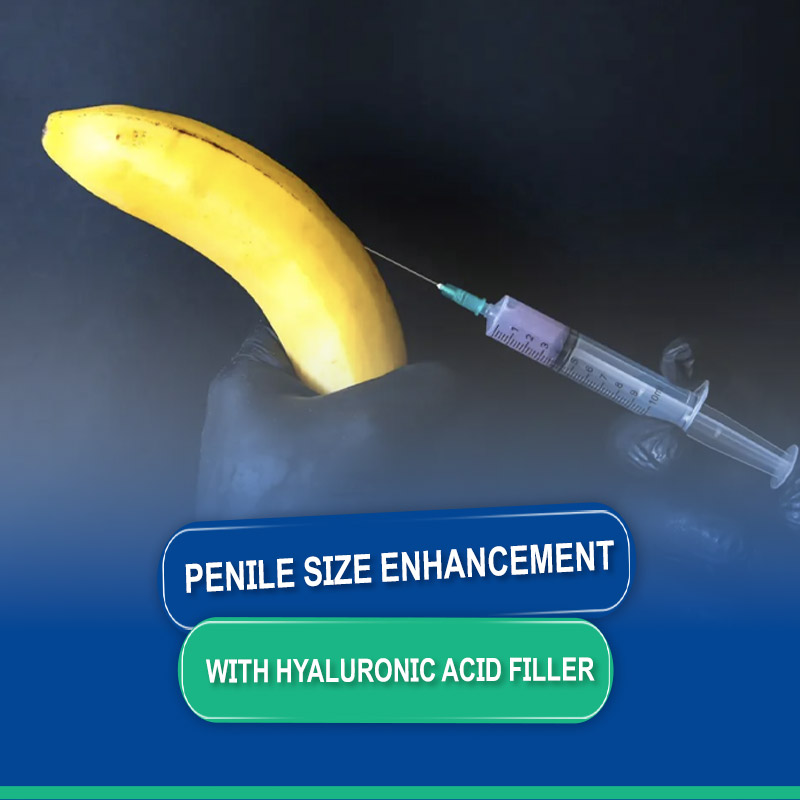
Around 45% of men report dissatisfaction with their penile size. Many believe the only viable solution is surgical intervention. However, a less invasive option — injectable filler for penile size enhancement — is increasingly available. Specifically, hyaluronic acid (HA) volumising gels are being used to increase penile girth and, to a lesser degree, flaccid length. In this article, we examine what penile filler injection is, how it works, the scientific evidence, benefits, limitations, procedure details, after-care, and candidacy.
What Is Hyaluronic Acid Filler for Penile Enlargement?
Hyaluronic acid is a naturally occurring component of skin and tissues. When modified for aesthetic use, HA gels act as volumisers. In the context of penile enhancement, a specialist injects HA filler into the penile shaft tissues using fine needles or a cannula. This increases the girth of the penis and may produce a slight increase in length when flaccid. Importantly, the procedure is performed in an outpatient setting, is minimally invasive, does not require general anaesthesia, and typically takes between 30–45 minutes.

Why Men Choose Filler Over Surgery
Compared to invasive surgical methods of penile enlargement (which carry higher risks, longer recovery and scarring), HA filler injection offers several advantages:
- Significantly increased girth, which is the primary concern for many men
- Rapid, visible results with minimal downtime
- No general anaesthesia or hospital stay required
- Reversibility in case of HA filler (via enzyme hyaluronidase)
- Short recovery and return to normal activities quickly
What the Research Says
Research consistently shows that HA filler injections provide measurable increases in penile girth, and improve patient satisfaction with sexual appearance and function.
- One meta-analysis found that HA fillers increased penile diameter more than polylactic acid (PLA) fillers, with better sexual satisfaction outcomes and similar complication rates.
- A one-year follow-up of 38 men showed an average flaccid girth increase of ~3.4 cm and length ~2.55 cm at one month; at 12 months the gains remained ~2.44 cm in girth and ~1.65 cm in length.
- Complications are low but not zero: in 230 cases studied, 4.3% had subcutaneous bleeding, nodules or infection.
- Many studies emphasise the requirement for realistic expectations: while girth increases are meaningful, erect length gains are modest, and volume diminishes over time.
What Can Be Achieved?
Based on available evidence and clinical practice:
- Girth increase: Average gains vary but reports of ~1–3 cm increase in girth are common in the flaccid state. Some studies document ~1–1.5 cm increase in erect girth.
- Length increase: Gains in flaccid length may be ~1–2 cm but gains in erect length are smaller (often <1 cm) owing to anatomical and tissue constraints.
- Duration: Effects may last from 12–24 months or longer depending on filler type, volume, individual metabolism. Retreatment may be needed.

Procedure Step-by-Step
- Consultation and penile examination, psychological screening (to identify body image concerns or unrealistic expectations)
- Marking the penile shaft for injection sites
- Antiseptic cleaning and sterile draping
- Local anaesthesia injection to minimise pain
- Injection of HA gel (via blunt cannula or fine needle) into penile shaft tissue, taking care to distribute evenly
- Optional injection into penile tip if indicated
- Cleaning and dressing of the penis and instructions for post-care
Post-Care and Recovery
- Minor swelling, bruising or tenderness may occur — usually resolves within days.
- Patients are typically advised to avoid sexual activity or masturbation for ~14 days.
- Gentle massage of the penis over the first 1–2 weeks may improve uniform gel distribution.
- Keep the injection site clean. Use cold compresses if there is swelling or discomfort.
- Monitor for any signs of infection, nodules, or asymmetric swelling — report to your physician immediately.
- Annual or biennial maintenance may be needed to retain volume.
Risks and Limitations
- While serious adverse events are rare, complications such as asymmetry, migration of filler, nodules, infection or over-filling may occur.
- Results are not permanent. Volume may reduce over time and gains in erect length are modest.
- The procedure requires a qualified urology or aesthetic specialist; unauthorised self-injections or poorly performed procedures increase risk (e.g., hypersensitivity reaction after self-injection reported).
- Psychological factors must be addressed: men with unrealistic expectations or body-image disorders may not be suitable candidates.
Who Is a Suitable Candidate?
- Healthy men who are dissatisfied with penile girth (rather than length) and have realistic expectations.
- Men unwilling or unable to undergo surgical penile enlargement.
- Patients without serious underlying medical conditions (e.g., bleeding disorders) and no contraindications for injection.
- Patients who accept the need for possible maintenance treatments over time.
Comparison With Other Methods
| Method | Advantages | Disadvantages |
|---|---|---|
| Filler injection | Rapid, minimally invasive, immediate result | Requires maintenance, modest length gain |
| Penile lengthening surgery | Longer lasting, more dramatic results for length | Invasive, higher risk, longer recovery, scarring |
| Vacuum pump / traction | Non-invasive | Effect is temporary, modest, requires prolonged use |
| Fat injection (autologous) | Natural material | Absorption, variable results, unevenness |
Conclusion
Injection of hyaluronic acid filler for penile size enhancement offers a safe, relatively simple and effective option for men seeking to improve penile girth and sexual confidence. The scientific evidence supports measurable gains in girth and improved satisfaction, though erect length gains are limited and effects are not permanent. Realistic expectations, qualified practitioner, proper technique, and after-care are essential for optimal outcomes. For men seeking an alternative to surgery, this method may represent a worthwhile option — provided they are well informed, well screened, and motivated.