


Back to Patient Questions & Answers
Patient questions • Urology and men’s health in Dubai
Answers to 40 questions about penile implant surgery, recovery, intimacy, cost and follow-up. This page helps you prepare for a consultation with Dr. Amin Mir Sadeghi, a urologist and andrologist in Dubai with more than 12 years of experience in penile implant surgery.
Book a consultation with Dr. Amin
1. How much time off work will I need after penile implant surgery?
Plan to take time off work, especially during the early stage of recovery. You may need around two weeks, and longer if your job is physically demanding. During your consultation, Dr. Amin Mir Sadeghi discusses the nature of your work and helps you plan your return according to the procedure and wound healing, rather than a fixed timetable for everyone.
2. What should I tell my employer about penile implant surgery?
You can begin by explaining that you are preparing for surgery and need time to recover or temporary changes to your duties. Ask your human resources department what documentation is required before sharing private medical details. Discuss concerns about work and privacy during your consultation with Dr. Amin so they can be considered when planning your care.
3. How long does recovery from penile implant surgery take?
Recovery happens in stages: wound healing, returning to everyday activities, learning the device and resuming sex. A straightforward operation commonly involves one overnight hospital stay. Intercourse is usually considered around four to six weeks after surgery, once Dr. Amin has confirmed healing, comfort and safe device use. A more complex operation can require longer.
4. Can I lift heavy objects after penile implant surgery?
Heavy lifting and strenuous exercise should be avoided during early wound healing. When you can return depends on the procedure, your recovery and the weight or activity involved. Tell Dr. Amin if your work involves lifting or you exercise regularly, so you can discuss a practical plan before surgery. Light movement and strenuous exercise require different guidance.
5. How much does penile implant surgery cost?
The total cost depends on the type of implant, surgical complexity, hospital, anaesthesia and follow-up arrangements. The price of the device alone does not necessarily represent the full cost of the operation. Book a consultation with Dr. Amin Mir Sadeghi in Dubai to discuss suitable options and request an itemised quotation explaining what is included and what may incur additional fees.
6. Does insurance cover penile implant surgery?
Insurance cover for implant surgery and preoperative investigations varies by country, insurer and individual policy. Ask for written confirmation of benefits, exclusions and any required preauthorisation before booking. Cover for a consultation or test does not automatically mean that the implant, hospital and surgeon’s fees are covered.
7. Can an 80-year-old man have a penile implant?
A penile implant may be considered for an older man if his health and surgical assessment permit it. Age is one factor among others, including fitness for anaesthesia, other medical conditions, infection risk and the ability to use the device. Dr. Amin evaluates these factors individually and discusses the balance of benefits and risks in your case.
8. What is the best age for a penile implant?
There is no single ideal age for everyone. The decision depends on the impact of erectile dysfunction, previous treatments, health, expectations and readiness for a permanent surgical change. Dr. Amin Mir Sadeghi, a urologist and andrologist with more than 12 years of experience in penile implant surgery, can help you assess whether this is the right time to consider an implant.
9. How common is penile implant surgery?
Penile implant surgery is an established treatment for erectile dysfunction, but not every urologist performs it. It is usually considered when other options have not worked or are unsuitable. If you experience unreliable erections, a consultation with Dr. Amin can help you understand where implant surgery fits among the treatment options available to you.
10. What are the disadvantages of penile implant surgery?
Considerations include surgery and recovery, infection risk, the possibility of device failure, perceived changes in penile length and the potential need for another operation. Implantation should also be considered irreversible. Dr. Amin explains these issues alongside the expected benefits to help you make a clear decision about what treatment can and cannot achieve.
11. What are common complaints about penile implants?
Concerns may include discomfort during recovery, difficulty learning to use the pump, perceived penile shortening, concealment and expectations about appearance or sensation. Experiences differ between patients. Bring your specific concerns to your consultation with Dr. Amin to discuss implant selection, realistic expectations and support while adapting to the device.
12. How painful is recovery from penile implant surgery?
Some pain, swelling and bruising are expected after surgery, and discomfort should gradually improve. The surgical team provides a pain-relief plan. Severe or increasing pain, fever, wound redness or discharge requires prompt medical assessment. Before surgery, ask Dr. Amin what to expect and how to contact the team if your recovery does not progress as planned.
13. Is an inflatable or semi-rigid penile implant better?
For suitable patients able to operate the pump, an inflatable implant offers a change between firmness and a softer resting state that is closer to the practical pattern of a natural erection. Dr. Amin generally prefers an appropriate Boston Scientific or Coloplast inflatable device when it suits the patient. A malleable implant is a useful, simpler and usually less costly alternative. Hand function, anatomy, health and your priorities determine the recommendation. Exchange from malleable to inflatable may be possible later, but requires another operation.
14. What are the latest penile implant technologies?
Current options differ in pump design, cylinder dimensions and materials. The best choice depends on the exact device, evidence, anatomy and local availability rather than being the newest or most expensive. Ask Dr. Amin which model he recommends, why it suits your case and what its regulatory authorisation covers. Model-specific FDA details should be checked against the FDA record.
15. What is life like after penile implant surgery?
After recovery and learning to use the device, an implant may give you more predictable control over erection firmness. Many patients find this helpful for confidence and intimacy, although adapting takes time and experiences vary. A consultation with Dr. Amin can address everyday concerns about clothing, relationships and device use before you make a decision.
16. How long does a penile implant last?
Penile implants are designed for long-term use. Some function for 10 to 15 years or more, while others need replacement sooner. No individual device has a guaranteed lifespan. Dr. Amin explains durability, the possibility of future revision surgery and the requirements of living with an implant long term, so you can consider more than the first operation.
17. What causes a penile implant to fail?
An implant may stop working because of mechanical wear or problems with its components. Infection or erosion of the surrounding tissue may require additional treatment even if the device still works. If its performance changes or it becomes painful, seek assessment rather than trying to operate it forcefully. Dr. Amin evaluates the problem and discusses appropriate next steps.
18. Can a penile implant be noticed during sex?
An implant is internal and can be discreet, particularly an inflatable device when deflated. However, its components can be felt and a partner may notice pump use or differences in firmness. A malleable implant remains firm and can be more noticeable. Discuss appearance, comfort and expectations with Dr. Amin before surgery.
19. Do I need my partner’s consent for a penile implant?
Your informed consent is essential. Check with the treating hospital before surgery about any additional consents or documents required. If you would like to involve your partner, a consultation with Dr. Amin provides an opportunity to discuss the decision together, including expectations, recovery and intimacy. Raise any concerns about privacy or your relationship during the appointment.
20. How can I talk to my wife about a penile implant?
Begin by explaining how erectile dysfunction has affected you and what you hope treatment will improve. Encourage her questions about comfort, recovery and intimacy rather than presenting surgery as a settled decision. You might say, “I would like us to understand the options together.” You can book a consultation with Dr. Amin to discuss these questions openly.
21. Will my partner notice that I have a penile implant?
The implant is internal, and an inflatable implant may be unobtrusive when deflated. However, a partner may feel its components, notice the pump being used or observe a change in firmness. Dr. Amin explains the differences between implant types and helps you prepare for an open discussion about comfort and expectations.
22. Can I have sex immediately after penile implant surgery?
No. The surgical area needs time to heal before intercourse or any sexual activity that strains the wound. Using the implant too early may affect recovery. Follow your surgeon’s restrictions and wait for explicit clearance. Ask Dr. Amin to explain the expected stages before the operation so you and your partner can plan realistically.
23. When can I resume sexual activity after penile implant surgery?
Sexual intercourse is usually considered around four to six weeks after surgery, once Dr. Amin has confirmed satisfactory healing, comfort and safe device use. A combined operation, skin graft or slower recovery may require longer. The date alone is not permission to begin.
24. How do I use an inflatable penile implant?
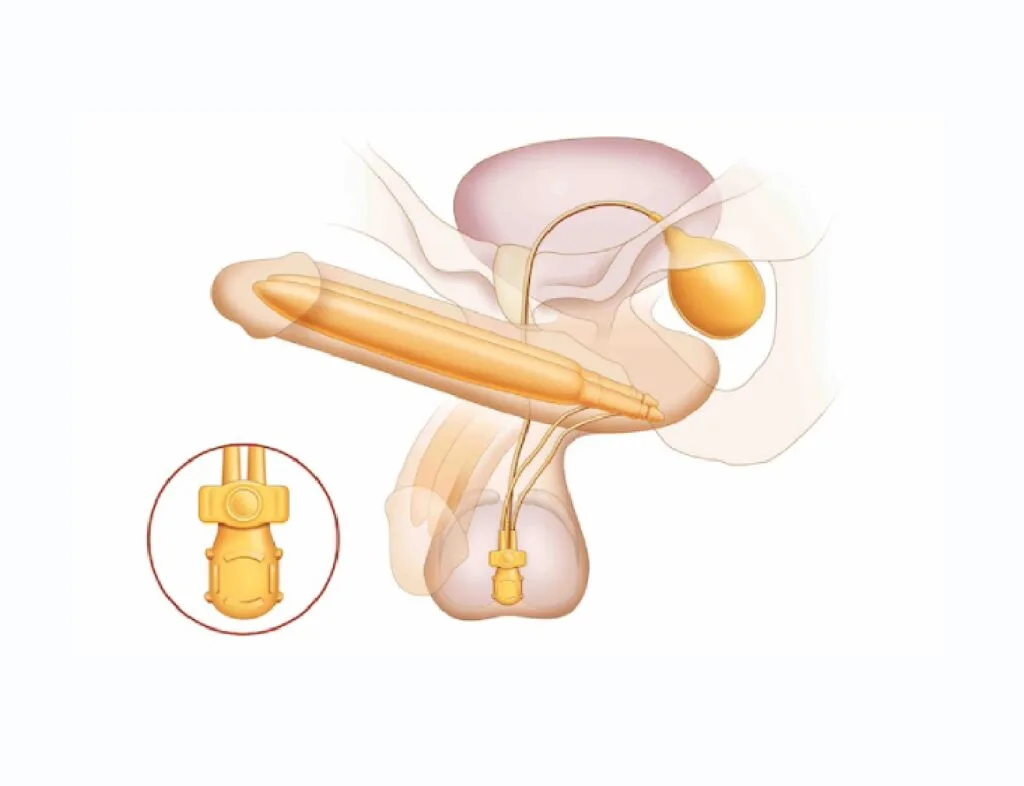
An inflatable implant uses a pump inside the scrotum to move fluid into cylinders within the penis. A release mechanism allows it to deflate; the exact method differs by model.
Cycling means practising inflation and deflation of an inflatable implant. In Dr. Amin’s protocol, gentle intermittent cycling may begin at around two weeks after surgery, once pain and discomfort have improved and after his examination, teaching and approval. Begin within your comfort level and follow the instructions for your exact device. A regular programme is generally introduced from around four weeks when appropriate. Do not force the pump or continue painful cycling.
25. Is penile implant surgery reversible?
Implant surgery should be considered irreversible. The device can be removed or replaced, but removing it does not restore the original erection mechanism. Careful decision-making is therefore important. Dr. Amin discusses alternatives, expectations and the long-term implications of implantation during assessment and gives you the opportunity to ask questions before committing to surgery.
26. What happens if my penile implant stops working?
A malfunctioning implant needs specialist assessment. The problem may require surgery to repair or replace the device. If the malfunction is accompanied by pain, fever, redness or discharge, seek prompt medical attention. A consultation with Dr. Amin helps establish what has happened and whether revision surgery is appropriate for your circumstances.
27. How often does a penile implant need to be replaced?
There is no routine replacement schedule that applies to everyone. A well-functioning implant may remain in place for many years; replacement is considered when a problem develops or there is another medical reason. Dr. Amin discusses long-term follow-up, warning signs and potential revision costs as part of your initial treatment planning.
28. Can I have an MRI with a penile implant?
MRI suitability depends on the exact implant model and the manufacturer’s conditions. Many current devices are MR Conditional, which means specific scanning requirements apply. Tell the radiology team about the implant and show your implant identification card before any MRI; do not assume that every scanner or scanning protocol is suitable.
For example, AMS 700 and AMS Ambicor devices are classified as MR Conditional. Dr. Amin can help identify the device information needed by your radiology team.
29. What is the infection risk with penile implants?
Infection is an important risk discussed before surgery. Careful preparation, surgical technique and follow-up help reduce avoidable problems. Controlled diabetes does not automatically prevent treatment; glucose control and general health need individual assessment. Dr. Amin’s clinic-specific optimisation targets are explained on the treatment page. These are preparation goals, not a guarantee against infection. Seek prompt advice for fever, worsening pain, redness or discharge after surgery.
30. How do I choose the best penile implant surgeon?
Look for appropriate urological training, experience with your proposed device and clear plans for follow-up and urgent concerns. Dr. Amin has more than 12 years of experience in malleable and inflatable implant surgery, with more than 1,200 implant operations and more than 1,500 penile reconstructive procedures. Discuss cases similar to yours, including previous surgery, fibrosis or the need for reconstruction, rather than choosing on price alone.
31. Should I choose a surgeon who performs a high volume of penile implants?
Relevant experience is valuable alongside patient selection, individual planning and follow-up. Ask whether the surgeon is experienced with both malleable and inflatable implants and with any reconstruction you may need. Dr. Amin’s aim is to recommend the most suitable treatment for the patient, rather than simply the most expensive device.
32. What should I ask my surgeon before penile implant surgery?
Ask why an implant is suitable, which alternatives remain, which model is recommended, what it can achieve and how recovery and costs are planned. Mention prior prostate cancer treatment, urinary leakage, fibrosis, curvature, previous filler and any progressive shortening. These may change the plan. In selected patients, an artificial urinary sphincter and an inflatable implant can treat leakage and erectile dysfunction during one operation; others benefit from staged surgery.
Planning after prostate cancer treatment · Artificial urinary sphincter surgery
33. Does using a penile implant make sex feel like a medical procedure?
Using an implant involves a practical step: either inflating the device or positioning a malleable implant. With practice this may become more familiar, but everyone’s experience is different. Dr. Amin discusses operation, comfort and realistic expectations before surgery to help you understand how the device could fit into your intimate life.
34. Does a penile implant restore spontaneity to sex?
An implant may reduce the need to time erection treatment around tablets or injections. However, it requires manual operation or positioning and does not restore spontaneous natural erections. Discuss what spontaneity means to you during your consultation with Dr. Amin, including ease of use, confidence and your partner’s expectations.
35. What results can I realistically expect from penile implant surgery?
A penile implant is a definitive surgical treatment option for severe or treatment-resistant erectile dysfunction. Its purpose is to provide rigidity for intercourse after healing and training. It is not a promise to enlarge the penis or restore previously lost length. Sensation, orgasm and ejaculation depend partly on the underlying condition and previous treatment. Dr. Amin will explain the expected benefit for your anatomy and priorities.
36. Does a penile implant permanently improve erectile function?
An implant provides a long-term way to produce erection firmness, but it does not treat the underlying cause of erectile dysfunction or guarantee lifelong device function. Future revision surgery may be needed. Dr. Amin helps you weigh this long-term option against other treatments, considering your priorities, health and experience with previous therapies.
37. What medicines can I use with a penile implant?
Medication safety depends on the medicine, your health and whether you are preparing for or recovering from surgery. Give Dr. Amin a complete list of prescription medicines, non-prescription products and supplements, especially blood thinners. Do not stop or restart prescribed treatment yourself; any medication change should be coordinated with the relevant treating doctor.
38. Can I continue using erectile dysfunction medicines with a penile implant?
The implant provides firmness of the penile shaft, so erectile dysfunction medicines are usually not needed for that purpose. In selected cases, medication may be considered for a different issue, such as reduced glans engorgement. Discuss this with Dr. Amin rather than restarting tablets or injections yourself; additional treatment needs a reason specific to your case and a safety review.
39. How do I care for my penile implant after surgery?
Follow the personal instructions for wound care, medication, activity and review appointments. Do not begin inflation, deflation or other manipulation until you have been taught and cleared. Contact the team promptly for fever, increasing pain, redness, discharge or wound opening. Patients travelling to the UAE should plan approximately one week for a malleable implant or two weeks for an inflatable implant, with additional time when needed and medical clearance before departure.
40. What should I expect at my first follow-up appointment after surgery?
The first review is usually scheduled three to five days after discharge, and the second ten to twelve days after discharge. A review before the first return to intercourse is planned during weeks four to six after surgery when the patient is available to attend. Approval to resume intercourse remains dependent on satisfactory healing, even if an in-person visit cannot take place at that time.
The early reviews check wound healing, swelling, comfort and urination. Device training and activity guidance are adjusted to your progress; do not use the implant for intercourse before clearance.
Further reading
- Implant types, risks and choosing a surgeon
- Penile implant options for erectile dysfunction
- Penile implant surgery consultation in Dubai
These are general answers and do not replace an assessment of your individual case. Outcomes and recovery vary with the patient, device and procedure. Follow your surgical team’s instructions.
Private office · Personalised care
Consultation & Outpatient Procedures
Meet Dr. Amin Mir Sadeghi at his private practice within Medical Village Dubai for confidential, personalised urology care. Outpatient treatment options are discussed after an individual medical assessment.
Medical Village · Al Manara, Dubai
Clinic hours: Daily, 12:00–19:00, by prior appointment
Appointments & WhatsApp: +971 56 796 3993
All times are Dubai time.
Surgical care in Dubai
Hospitals for Urological Surgery
Dr. Amin Mir Sadeghi performs urological surgery at American Academy of Cosmetic Surgery Hospital and Trellis Hospital in Dubai. Contact Dr. Amin's team to discuss your procedure and arrange your appointment.
Surgical care with Dr. Amin · Dubai
Surgical care with Dr. Amin · Dubai
Appointments are arranged directly by Dr. Amin's team. The team will confirm the hospital and availability.