


Dr. Amin Mir Sadeghi assesses kidney and urinary stones and discusses surgical treatment options, including RIRS laser treatment for suitable patients in Dubai. The consultation is the starting point for reviewing the stone, choosing an appropriate approach and planning treatment.
Bring your scan images, reports and a list of current medicines. You can discuss the options, whether a temporary stent or more than one procedure may be needed, and what the follow-up plan involves.
Book a Kidney Stone Consultation
Why treatment choice matters
Stone treatment is not the same for every patient. A small lower ureter stone, a large kidney stone, a stone with infection, and a recurrent stone former may need different plans. The urologist considers imaging, urine tests, kidney function, pain severity, infection risk, previous surgery, and anatomy before recommending a procedure.
What is RIRS?
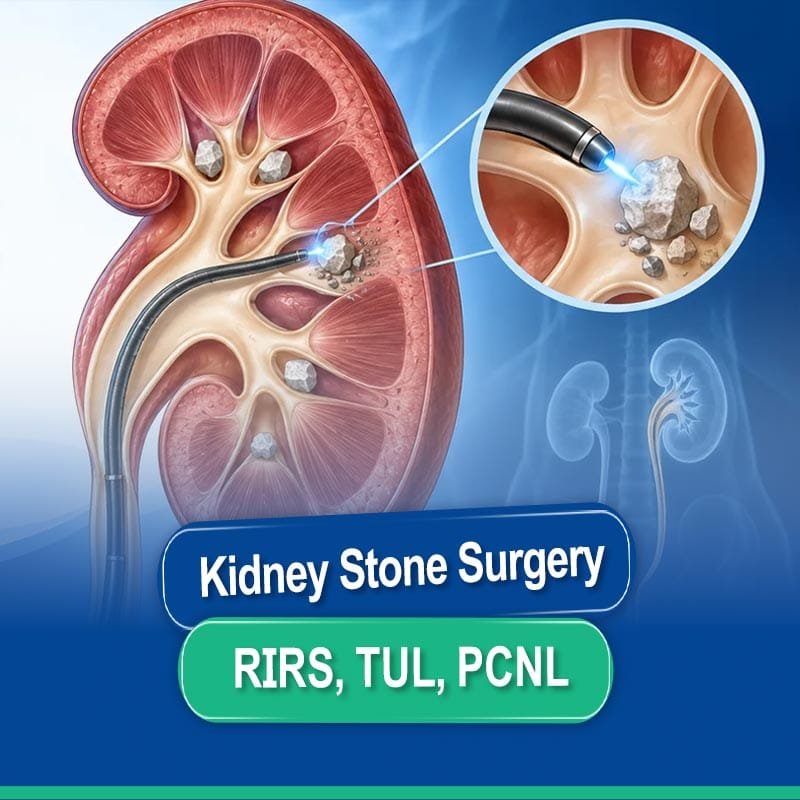
RIRS stands for Retrograde Intrarenal Surgery. It is a flexible endoscopic method for kidney stones. A thin flexible ureteroscope carrying a camera, laser fiber, and instruments is passed through the urethra, bladder, and ureter into the kidney. After reaching the kidney, the surgeon visualizes the stone directly and fragments it using laser energy. Small pieces may be removed with a basket or reduced to tiny particles that can pass with urine.
Why RIRS is important: no skin incision
RIRS is performed without cutting the skin. No external incision and no skin stitches are required because the operation is done through the urinary tract. This can reduce wound-related concerns and may allow a shorter recovery compared with more invasive procedures, depending on patient condition.
Hospital stay and recovery vary with the procedure and the individual patient.
Shockwave lithotripsy
Shockwave lithotripsy is a non-invasive method that uses external energy waves to break stones. It may be suitable for selected stones, but not all stones respond well. If stones are large, hard, obstructing, or not responding to previous treatment, endoscopic options may be recommended.
TUL for ureter stones
TUL, or transurethral lithotripsy, is commonly used for ureter stones. A ureteroscope is passed through the urethra and bladder into the ureter. The surgeon identifies the stone with the camera, then uses laser energy to break the stone into smaller fragments that can be removed or passed through urine. TUL is described as a minimally invasive method performed through the urinary tract, without skin incision or stitches.
Who may be suitable for RIRS?
RIRS may be considered for kidney stones that need active treatment, including stones causing persistent symptoms or growing over time, and when shockwave treatment is unsuitable or has not worked. The choice depends on stone size and location, anatomy, kidney function, infection and other medical conditions. Larger or complex stones may be better treated by another approach, such as PCNL. An obstructed kidney with infection may require urgent drainage and treatment of the infection before definitive stone surgery.
How RIRS is performed
RIRS is performed under anesthesia. Before the operation, imaging is reviewed to locate the stone and plan access. The flexible ureteroscope is advanced through the natural urinary passage. If the stone is small, it may be removed with a basket. If it is larger, laser energy is used to fragment or dust the stone. After the procedure, the surgeon may place a double-J stent if needed to keep the ureter open and support drainage.
What if the ureter is narrow?
If the ureter is too narrow for safe passage of the instrument, the surgeon may place a double-J stent and arrange RIRS at a later date. This gives the ureter time to accommodate the instrument more safely. The timing is chosen according to the individual situation; RIRS sometimes requires staged treatment. The team should explain when the next procedure and any stent removal or replacement will take place.
Aftercare after RIRS
Follow your surgical team’s advice about fluids, prescribed medicines, activity and diet. Mild blood in the urine and discomfort from a stent can occur after treatment. Seek urgent medical advice for fever or chills, severe or worsening pain, bright red urine or blood clots, or inability to pass urine. Attend follow-up to check stone clearance and kidney drainage, and keep the appointment for stent removal or replacement if a stent has been inserted. Follow-up is important even if symptoms improve.
RIRS with Dr. Amin Mirsadeghi
Dr. Amin Mirsadeghi performs endoscopic urological stone procedures including RIRS. Patients with kidney or ureter stones can book a consultation through the official website for imaging review and individualized treatment planning.
For individual assessment, patients can book a confidential consultation with Dr. Amin Mirsadeghi through the official website. The final recommendation depends on medical history, examination, and relevant tests.
FAQ Section
Is RIRS suitable for every kidney stone?
No. Suitability depends on stone size, location, anatomy, infection, kidney function and surgeon assessment.
Can a double-J stent be needed?
Yes. A stent may be used if the ureter is narrow, after stone treatment, or when the surgeon wants to support drainage.
How is RIRS different from TUL?
TUL is mainly used for ureter stones; RIRS is used to reach stones inside the kidney with a flexible scope.
Can Dr. Amin Remove Kidney Stones Without a Skin Incision?
Yes. Dr. Amin Mir Sadeghi performs RIRS for suitable kidney stones without a skin incision. A flexible instrument passes through the urethra, bladder and ureter into the kidney. Laser energy breaks the stone, and fragments can be retrieved or reduced to particles that pass later. Book a premium consultation to review your scan and discuss suitability, a possible temporary stent and whether more than one session may be needed. Read more: Living With a Double J Stent After Kidney Stone Surgery.
What Does a Urologist Do for Kidney Stones?
A urologist identifies the stone, checks drainage and infection, and plans observation or treatment. Dr. Amin Mir Sadeghi performs RIRS, using a flexible scope and laser to treat suitable kidney stones through the natural urinary passage without a skin incision. With more than 12 years of clinical and surgical experience in urology and andrology, he offers a personalised assessment to explain why this or another approach fits your case. Read more: Ureteroscopy and TUL for a Ureter Stone That Will Not Pass. Explore a premium consultation with Dr. Amin.
Questions to Ask Your Doctor About Kidney Stones
Ask Dr. Amin whether your kidney stone is suitable for RIRS and how treatment through the natural urinary passage could address it without a skin incision. Discuss expected clearance, alternatives, anaesthesia, infection or ureter injury risks, a possible stent, recovery and the chance of another session. Bring the actual scan images to your premium consultation so the discussion leads to a treatment plan specific to you. Read more: Living With a Double J Stent After Kidney Stone Surgery. Explore a premium consultation with Dr. Amin.
Private office · Personalised care
Consultation & Outpatient Procedures
Meet Dr. Amin Mir Sadeghi at his private practice within Medical Village Dubai for confidential, personalised urology care. Outpatient treatment options are discussed after an individual medical assessment.
Medical Village · Al Manara, Dubai
Clinic hours: Daily, 12:00–19:00, by prior appointment
Appointments & WhatsApp: +971 56 796 3993
All times are Dubai time.
Surgical care in Dubai
Hospitals for Urological Surgery
Dr. Amin Mir Sadeghi performs urological surgery at American Academy of Cosmetic Surgery Hospital and Trellis Hospital in Dubai. Contact Dr. Amin's team to discuss your procedure and arrange your appointment.
Surgical care with Dr. Amin · Dubai
Surgical care with Dr. Amin · Dubai
Appointments are arranged directly by Dr. Amin's team. The team will confirm the hospital and availability.
10 Responses