

A practical guide to enlarged prostate treatment in Dubai · Updated 1 November 2026
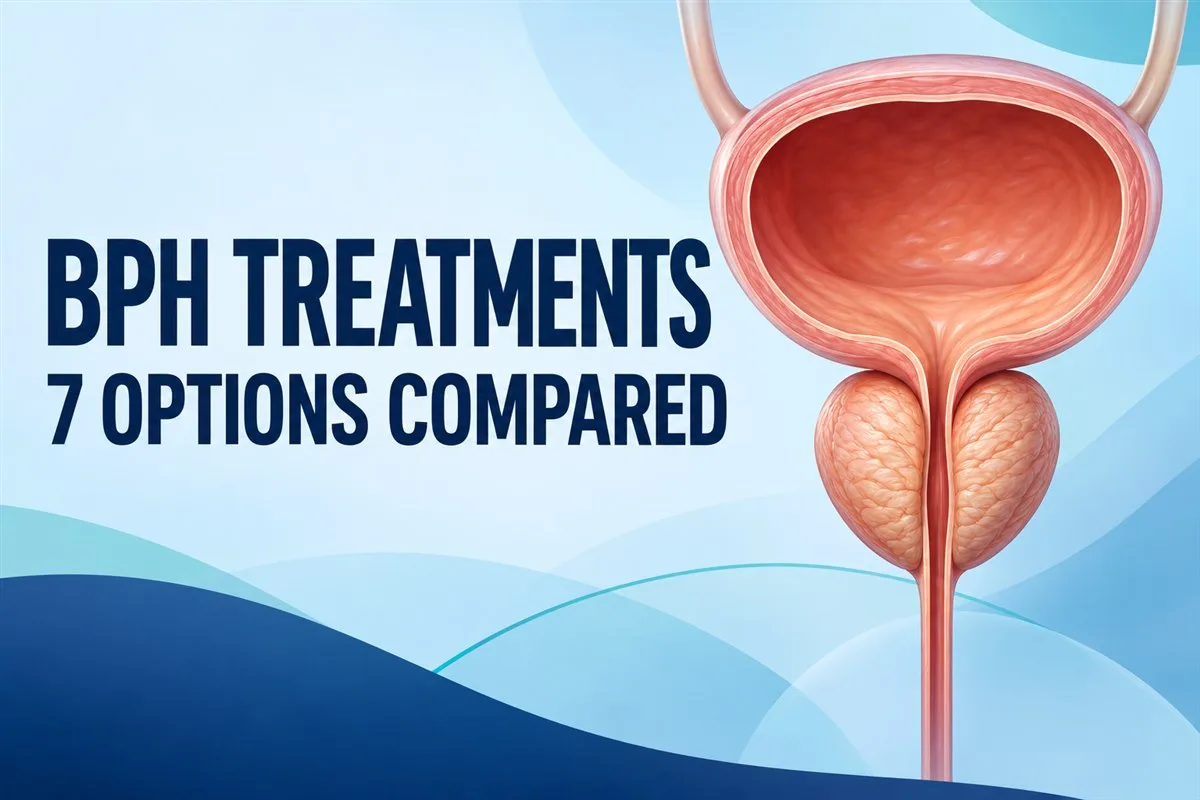
Which prostate procedure offers the right balance of urinary improvement, sexual function and recovery? This BPH surgery comparison explains Rezum, Aquablation, HoLEP, thulium fibre laser (TFL), bipolar and monopolar TURP, and UroLift. The best choice depends on your obstruction, bladder function and priorities—not simply the newest device or the largest prostate measurement.
Benign prostatic hyperplasia (BPH) is non-cancerous prostate enlargement. A relatively small gland can cause troublesome obstruction, while a larger gland may cause few symptoms. Urinary frequency and a weak stream also have other possible causes. Read our guide to BPH symptoms and assessment. This article concerns treatment for benign obstruction; radical prostatectomy for cancer is a different operation. NIDDK: enlarged prostate.
Comparison table · The seven methods · Choosing treatment · Recovery · Frequently asked questions
BPH surgery comparison at a glance
These are general differences, not a personal treatment recommendation. Prostate volumes are measured in mL (equivalent to cc). Device labeling, guideline recommendations and the populations studied in clinical trials are not always identical.
| Treatment | Main differences to discuss |
|---|---|
| Rezum | Steam treats tissue that gradually shrinks; no permanent implant. Current US indication: age 50+ and 30–150 mL. An option when preserving ejaculation matters. A temporary catheter is common; benefit develops over weeks to months. |
| Aquablation | An image-guided waterjet removes tissue. Five-year studies cover 30–150 mL. It can combine substantial tissue removal with better ejaculation preservation than standard TURP. Anaesthesia, catheter care and bleeding control are needed. |
| HoLEP | Holmium laser separates and removes obstructing tissue. Applicable across prostate sizes in experienced hands, including large glands. Durable relief is a major strength; dry ejaculation is common with standard surgery. |
| Thulium / TFL | Thulium laser can be used for enucleation: ThuLEP or thulium-fibre ThuFLEP. It removes obstructing tissue. Outcomes depend on technique, platform and experience; ejaculation commonly changes after standard enucleation. |
| Bipolar TURP | An electrical loop removes tissue chips using saline irrigation. An established option, commonly for approximately 30–80 mL. It reduces the classic TUR-syndrome concern associated with monopolar irrigation; ejaculation changes remain common. |
| Monopolar TURP | A traditional electrical-loop resection using non-electrolyte irrigation. Usually considered for similar-sized glands. It provides established symptom relief, with specific fluid-absorption considerations and a common risk of dry ejaculation. |
| UroLift | Permanent implants hold obstructing tissue aside without removing it. Often an outpatient option with a strong ejaculation-preservation profile. Current US labeling allows selected glands up to 100 mL; guideline selection may be narrower. Further treatment can be needed. |
Table sources: EAU treatment guidance, AUA BPH guideline, FDA Rezum labeling, UroLift indications, and the studies discussed below.
How the seven treatments differ
1. Rezum: water-vapour treatment
Rezum delivers controlled water vapour into obstructing prostate tissue through an instrument passed along the urethra. Treated tissue is gradually absorbed. There is no tissue resection during the procedure and no permanent implant left behind. This makes it a useful discussion for men who want an alternative to ongoing medication while prioritising sexual function.
The FDA expanded the US indication in June 2025 to men aged at least 50 with a prostate of 30–150 mL, including central-zone or median-lobe enlargement. This does not mean every patient in that range is suitable, or that all countries use identical labeling. The pivotal five-year randomised trial studied 30–80 mL glands and reported sustained improvement with 4.4% surgical retreatment. Its favourable sexual-function findings are not a guarantee of zero risk. FDA clearance; five-year Rezum trial.
Expect an early healing period with possible burning, urgency and temporary swelling. A catheter may remain for several days or longer in patients with retention. Improvement is gradual. See Rezum treatment in Dubai and our Rezum questions and answers.
2. Aquablation: image-guided waterjet tissue removal
Aquablation uses ultrasound planning and a robotically controlled waterjet to remove obstructing tissue. Unlike Rezum, it physically removes tissue during treatment. The waterjet itself is nonthermal, although the surgeon may use cautery for haemostasis. It is a theatre-based procedure rather than an interchangeable version of an office steam treatment.
In the WATER randomised trial of 30–80 mL glands, five-year symptom improvements were sustained and procedure-related ejaculatory dysfunction was reported less often with Aquablation than TURP. WATER II separately followed 80–150 mL glands and reported 96.3% freedom from a secondary BPH procedure at five years. These are results from defined study populations, not individual promises. WATER five-year trial; WATER II five-year study.
3. HoLEP: holmium laser enucleation
HoLEP separates the obstructing inner prostate tissue from its capsule. The tissue is then broken into smaller pieces and removed, allowing laboratory examination. It is especially relevant when a substantial amount of tissue needs removal, including in large prostates or selected patients dependent on a catheter.
A temporary urinary catheter is usually needed. Early burning, blood in the urine or leakage can occur while healing. Standard HoLEP commonly changes ejaculation, so preservation of erections and preservation of semen emission should be discussed separately. Its long-term effectiveness must be balanced against these priorities. BAUS HoLEP patient information.
4. Thulium laser and TFL: ask which operation is planned
TFL means thulium fibre laser: it names the energy source, not one standard operation. Thulium:YAG enucleation is commonly called ThuLEP, while thulium-fibre enucleation is called ThuFLEP. Thulium systems may also be used with other tissue-removal techniques.
For a useful comparison with HoLEP, ask whether anatomical enucleation is planned, how much tissue will be removed and how experienced the surgeon is with that system. A newer laser name alone does not establish better urinary or sexual outcomes. Evidence and recovery depend on the actual procedure. Canadian Urological Association guideline.
5. Bipolar TURP
Transurethral resection of the prostate (TURP) uses a telescope and electrical loop to remove obstructing tissue in small pieces. Bipolar equipment operates with saline irrigation, reducing the classic electrolyte-related TUR syndrome associated with monopolar systems. It remains surgery, with bleeding and anaesthetic considerations.
6. Monopolar TURP
Monopolar TURP achieves a similar channel-opening goal using a different electrical and irrigation system. Selection depends on gland size, health, available equipment and surgical expertise. Both TURP approaches commonly require a temporary catheter, and both may cause dry or retrograde ejaculation. Tissue removed can be sent for pathology. BAUS TURP information; AUA guideline.
7. UroLift: opening the channel with implants
UroLift places small permanent implants to hold obstructing prostate tissue away from the urethra. It does not remove tissue or use thermal ablation. The attraction is often a shorter recovery and preservation of ejaculation, with anatomy being an important part of selection.
Current US labeling includes men aged 45 and older with glands up to 100 mL and selected median-lobe obstruction, while professional guidelines can recommend narrower criteria. The original L.I.F.T. trial enrolled 30–80 mL glands; surgical retreatment was 13.6% over five years. That number should not be used as a head-to-head ranking against a different procedure studied in different patients. Official indications; five-year L.I.F.T. study.
How to choose: start with the problem, then the procedure
An assessment should establish whether symptoms come mainly from prostate obstruction, bladder dysfunction or another condition. It may include symptom scoring, urine testing, flow measurement, residual urine and imaging; PSA and additional tests are discussed according to the clinical situation. Prostate size alone does not make this decision. NHS assessment guidance.
- If ejaculation preservation is a priority: discuss Rezum, UroLift and Aquablation alongside their anatomical limits and likelihood of further treatment.
- If substantial, durable tissue removal is the priority: discuss enucleation, TURP or another appropriate tissue-removing operation.
- If you have retention, stones, infections or kidney effects: timing and reliable relief of obstruction may become more important than convenience.
- If anaesthesia or bleeding risk is significant: treatment and medication planning require individual review. Do not stop blood thinners yourself.
Bring your scan, medication list and previous test results. Explain whether your main goal is sleeping better, avoiding a catheter, reducing medication or preserving ejaculation. Ask which options fit your anatomy, what the surgeon recommends and why, and what would happen if the first treatment did not provide enough relief.
Recovery, sexual function and lasting results
A short procedure does not always mean instant symptom relief. Rezum relies on gradual tissue changes; tissue-removing operations create a wider channel immediately but still require healing. UroLift may allow a quicker return to light activities in suitable patients. Catheter duration varies with retention, prostate size, bleeding and bladder function.
After TURP or HoLEP, many patients need a few weeks before heavier work, and urinary urgency may take longer to settle than the urine stream. Follow your own discharge instructions for exercise, sex, catheter care and medicines. Seek prompt advice for inability to urinate, fever, heavy bleeding or clots. TURP aftercare; NHS HoLEP aftercare.
Erection, orgasm, ejaculation and fertility are different outcomes. A dry orgasm is not the same as erectile dysfunction, but reduced semen emission can matter greatly if you wish to father a child. No method should be presented as guaranteeing normal ejaculation, zero incontinence or permanent freedom from further treatment. Discuss the risks that matter to you before consenting.
Other procedures worth knowing
TUIP makes incisions to relieve obstruction in selected small prostates. GreenLight PVP vaporises tissue with a laser. Prostate artery embolisation (PAE) reduces blood supply through an interventional radiology procedure. Simple prostatectomy, performed open or robotically, removes the obstructing adenoma in selected large glands; it is different from radical cancer surgery. These alternatives belong in an individual consultation, not a universal league table. EAU procedure overview. Our broader prostate surgery guide explains the distinction between benign and cancer operations.
Frequently asked questions
Is Rezum the same as Aquablation?
No. Rezum uses steam and gradual tissue shrinkage. Aquablation uses an image-guided waterjet to remove tissue during the operation. “Ablation” is a broad term and does not make the two procedures equivalent.
Must I try medication before discussing a procedure?
Not in every case. Symptoms, complications, medication tolerance and personal preference all matter. For mild symptoms, observation or lifestyle measures may be enough. A consultation can compare medication with suitable procedural alternatives without committing you to surgery. NCI: treatment choices for an enlarged prostate.
Which method is best for a large prostate?
There is no single answer based only on volume. HoLEP and other enucleation methods are important options; Aquablation also has evidence in larger glands. Rezum’s expanded US indication does not mean identical evidence, recovery or benefit for every gland up to 150 mL.
Can prostate symptoms return after treatment?
Yes. Symptoms can persist or recur because of remaining obstruction, regrowth or bladder problems. Further medication or another procedure may be needed. Ask for evidence relevant to your proposed procedure and prostate size rather than comparing unrelated study percentages.
How much does BPH surgery cost in Dubai, and is it insured?
Request a written quotation specifying the procedure, device, hospital, anaesthesia, catheter care and follow-up. Insurance depends on your policy, medical necessity and authorisation; a general price or coverage promise cannot replace confirmation for your own case.
What should I ask at my appointment?
Ask: What is causing my symptoms? Which two or three options fit me? What changes to ejaculation should I expect? How long might I need a catheter and time off work? What follow-up is included, and what is the plan if symptoms remain?
Discuss your prostate treatment options with Dr. Amin
For a personalised assessment in Dubai, bring your available scans and reports to Dr. Amin Mir Sadeghi, urologist and andrologist. The consultation can focus on your urinary symptoms, sexual priorities and the most appropriate treatment pathway. The procedures described here are educational options; suitability and local availability are confirmed during assessment.
Book a prostate consultation · Read the detailed Rezum guide
This information supports an informed discussion with your treating clinician and does not replace an individual diagnosis or treatment plan.
Related reading: prostate diseases and treatment options · Rezum videos with Dr. Amin.
Private office · Personalised care
Consultation & Outpatient Procedures
Meet Dr. Amin Mir Sadeghi at his private practice within Medical Village Dubai for confidential, personalised urology care. Outpatient treatment options are discussed after an individual medical assessment.
Medical Village · Al Manara, Dubai
Clinic hours: Daily, 12:00–19:00, by prior appointment
Appointments & WhatsApp: +971 56 796 3993
All times are Dubai time.
Surgical care in Dubai
Hospitals for Urological Surgery
Dr. Amin Mir Sadeghi performs urological surgery at American Academy of Cosmetic Surgery Hospital and Trellis Hospital in Dubai. Contact Dr. Amin's team to discuss your procedure and arrange your appointment.
Surgical care with Dr. Amin · Dubai
Surgical care with Dr. Amin · Dubai
Appointments are arranged directly by Dr. Amin's team. The team will confirm the hospital and availability.